| |

|
Research Note · October 7, 2026 |
|
|
|
Momentous Sports
Research Note
By Trent Michels
Managing Director of Investments
|
The Easy Throw
College Sports · Capital · Congress
An 8U flag football halftime, the Protect College Sports Act, and why the best play for most universities is the land they already own.
| Charlotte, NC · ~13 min read |
|
|
My son’s team is the Seahawks this year. Last season they were the Beavers, and they went undefeated, which I took as proof that a man, that I, could coach my way into a legacy. This fall they moved up to 8U. The league held a draft, and I walked into it knowing almost nothing about the kids already playing in the division. I didn’t know who was fast, who was big, or who had been playing since he could walk. So I drafted what I knew. I took as many of last year’s kids as I could get. I valued the parents, the work ethic, and the fact that these boys already knew how to play together. In a room full of strangers, continuity felt like the safest pick on the board.
Two weekends ago we played the Falcons at Tega Cay Elementary. The Falcons had one kid at the older end of the age range, and their offense was simple. Hand him the ball and watch him run. It worked almost every time. It was diabolical. By halftime we had learned one of the oldest lessons in youth sports, which is that one player on the right side of the birthday cutoff can beat a good team by himself.
At halftime, the coaches and I changed our defense and built the whole thing around keeping that one kid inside. Then we changed the offense. I told our quarterbacks that if I counted past three seconds before the ball came out, or if they threw it more than ten yards downfield, they were coming out of the game. Most rule sets give a quarterback seven seconds. I gave ours three.
It sounds harsh for kids this age. It worked. At 8U a deep ball is a coin flip that lands on the other team. Somebody picks it off or somebody swats it down. Once our quarterbacks stopped hunting for the big play, they started finding the open kid standing right in front of them. We mixed in some misdirection, and the offense started clicking. If the second half had been the whole game, we would have won 14 to 7.
We bottled up their fast kid so completely that the Falcons started to come apart. Their players began flailing at ours, guarding their flags, and pushing on the sideline. I don’t say that to knock a group of seven- and eight-year-olds. I say it because it was the clearest thing I saw all day. When a team is built on one play, and that play stops working, discipline is the first thing to go.
We lost. It was still one of the best afternoons our kids have had. They learned that the easy throw in front of you beats the hero ball, and that a plan you stick to can neutralize talent you can’t match.
I spent the drive home thinking about college football, which is where I spend most of my working week. Every lesson from that second half has an expensive version in college sports, and Congress is about to call the next play.
|
The Price of the Big Kid |
|
In college the big kid has a price tag. In the first year of revenue sharing, schools paid athletes $1.77 billion directly, according to a College Sports Commission court filing reported by the Associated Press on October 1. Of the 319 schools that opted in, 68 hit the $20.5 million cap or came within 5 percent of it. Football took 63.8 percent of revenue-sharing dollars at the average top school, according to Opendorse data reported by Front Office Sports, and quarterbacks took 18 percent of football player compensation in Opendorse’s 2025 figures. On3’s model values Miami quarterback Darian Mensah’s NIL at $6.5 million. His leaving the Duke Blue Devils still makes me a bit spicy in a conversation.
The coach has a price tag too, and the case for paying it is real. Indiana went 3 and 9 in 2023. Two seasons later it went 16 and 0 and won the national title with starters who averaged 2.95 recruiting stars, 16 of them transfers, according to CBS Sports. Curt Cignetti’s revised contract now pays him $13.025 million a year. That was a halftime adjustment on a national scale, and every athletic director in the country watched it happen.
The research is more measured. In a 2019 paper, Christopher Berry and Anthony Fowler of the University of Chicago estimated that coaches explain something like 20 to 30 percent of the variation in team success, more in college football than in the NFL. A study of FBS programs from 1997 to 2010 by Adler, Berry and Doherty found that firing a coach for poor performance does not help on average. Bad teams improve a little for a short while, and middling teams get worse. Schools fire coaches anyway. FBS programs committed nearly $185 million in buyouts across 11 firings in 2025, according to Front Office Sports. LSU still owes about $54 million on Brian Kelly’s contract, according to On3. The 40 public universities in the ACC, Big Ten and SEC paid $1.14 billion in severance between 2005 and 2025 to coaches and administrators who no longer worked for them. Auburn alone paid $91.4 million.
|
Spending Past the Revenue |
|
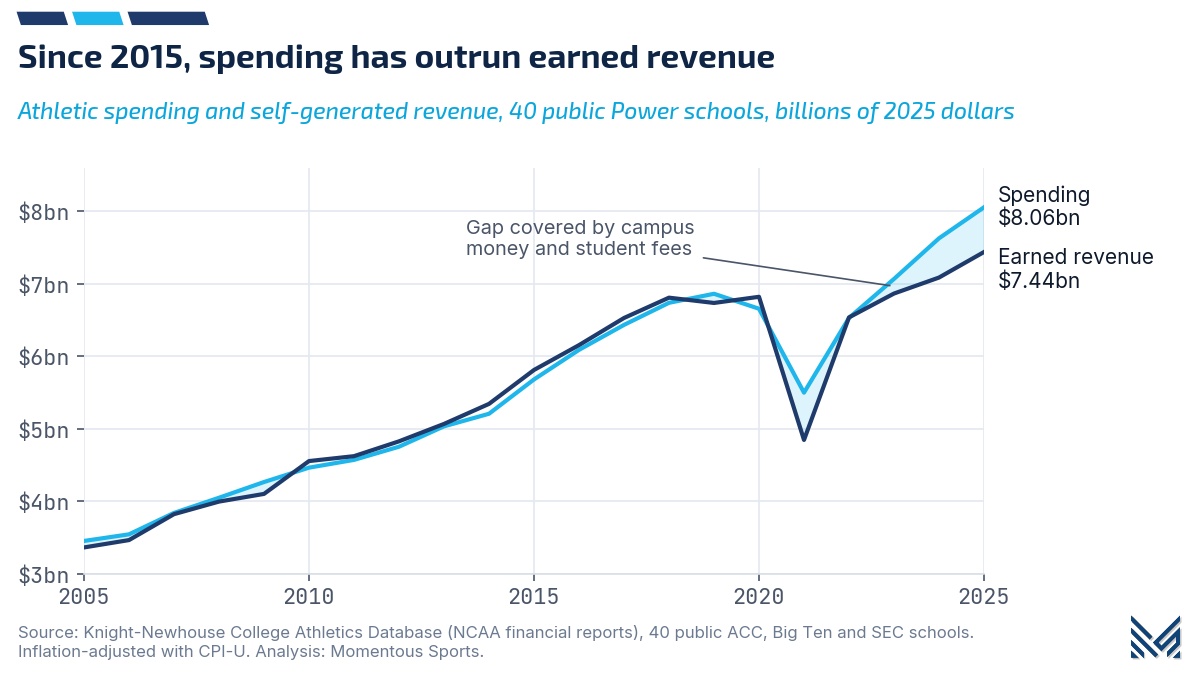
Last month I analyzed every NCAA financial report filed from 2005 through 2025 by those 40 schools, as compiled in the Knight-Newhouse College Athletics Database. Adjusted for inflation, the revenue they earned themselves, from media, tickets, sponsors and donors, grew by $1.63 billion between 2015 and 2025. Their spending grew by $2.38 billion. For every new dollar they earned, they added $1.46 in costs. Thirty-three of the 40 spent past their revenue growth.
Howard Bowen, the former president of Grinnell College and the University of Iowa, described the pattern in 1980. Universities raise all the money they can and spend all they raise. Greg Chick of NILnomics tested that idea on athletic departments in September and found they spent nearly every new dollar through 2019. Our filings show the same thing for that period, $1.01 of new spending per new earned dollar. Over the last decade, the ratio climbed to $1.46. Departments stopped spending what they raised and started spending more than they raised, and campuses covered the difference. Institutional support and student fees at the 40 schools rose 159 percent after inflation, to $531 million in 2025. Over 21 years, the schools put $4.65 billion of campus money and student fees into athletics.
The national numbers say the same thing. The Government Accountability Office reported on July 14 that 330 of 352 Division I programs spent more than they generated in 2023-24, including 49 of the 69 Power conference schools. The median Power school’s gap grew from $2.7 million to $15.2 million over the decade. Colleges contributed $7.2 billion to their athletic programs that year.
|
|
When the One Play Stops Working |
|
The Falcons’ sideline is a fair picture of what happens next. LSU projects a $26 million athletics deficit for 2026-27 after a $44 million shortfall last year that the Tiger Athletic Foundation covered, the Louisiana Illuminator reported on September 24. LSU’s president, Wade Rousse, described a plan built around a private equity deal tied to media rights. “We’ve got to stop that bleeding,” he said. Two days earlier, a member of the Louisiana Board of Regents suggested three of the state’s FBS programs consider dropping to the FCS.
At Kansas, the athletics board approved a $50 million line of credit by email in April, replacing a $35 million line, with eight members in favor. The athletics CFO told the board it “is secured by a guarantee from the university.” KCUR reported in September that the university was moving $16 million from academics to athletics for a second straight year. At North Carolina, trustees approved withdrawing $9 million from an athletics quasi-endowment that began as an $8 million Nike prepayment, The News & Observer reported on September 23. The Assembly reported in September that the department had spent $55 million more than it budgeted. In Wisconsin, the Legislature voted to send UW-Madison $14.6 million a year for athletic facility debt. The Senate vote was 17 to 16. New Jersey’s budget includes $5 million for Rutgers athletics while, according to Sen. Maria Cantwell’s staff, 38 lecturers received non-reappointment notices.
Then there are the fans. Virginia Tech’s new Invest to Win campaign sets season tickets at $350 plus a required donation, and it offers a cash-back app so fans can route their gas and grocery rebates to athletics, FOIAball reported on October 1. Nobody in this paragraph is a villain. They are all doing what the Falcons did in the second half, reaching for whatever is in front of them once the plan stops working.
|
The Deep Ball |
|
On September 28, the Senate passed the Protect College Sports Act, 77 to 22. Sen. Ted Cruz, the Texas Republican, and Sen. Cantwell, the Washington Democrat, built the bill on the premise that the problem is too little money. Its central promise is pooled media rights.
Cantwell’s September 15 staff report says amending the Sports Broadcasting Act “could bring in an additional $4 to 8 billion in media rights revenue.” The report has 39 footnotes. None is attached to that figure. Committee releases in March and May put the number at “more than $9 billion,” also without a source. The Congressional Budget Office, scoring the bill on July 31, described the largest conferences’ media rights as worth “about $20 billion over several years” and made no estimate of what pooling would add.
The Big Ten’s deals with Fox, CBS and NBC are worth about $1.1 billion a year. The SEC’s ESPN deal is about $300 million a year before the SEC Network. The Big 12 receives about $380 million, the College Football Playoff’s ESPN deal pays about $1.3 billion, and the men’s basketball tournament about $1.1 billion. A study commissioned by the American Athletic Conference put total FBS media value at about $3.5 billion a year. Add up the major contracts, and you get a little more than $5 billion. New money of $4 billion to $8 billion would mean raising college media revenue by 77 to 229 percent, close to or past the NFL’s roughly $10 billion a year.
The structure makes the deep ball harder to complete. A pool needs at least 75 percent of FBS schools, which is 102 of 136. The SEC and Big Ten, which hold the largest contracts, backed the bill in July only after participation became voluntary, and their February FTI Consulting study called pooling “a dangerously unworkable model.” Without their 34 schools, a pool would need every other FBS program and would start from roughly $800 million in conference rights. Current contracts run from 2030 to 2036, so pooled money could not arrive until about 2031.
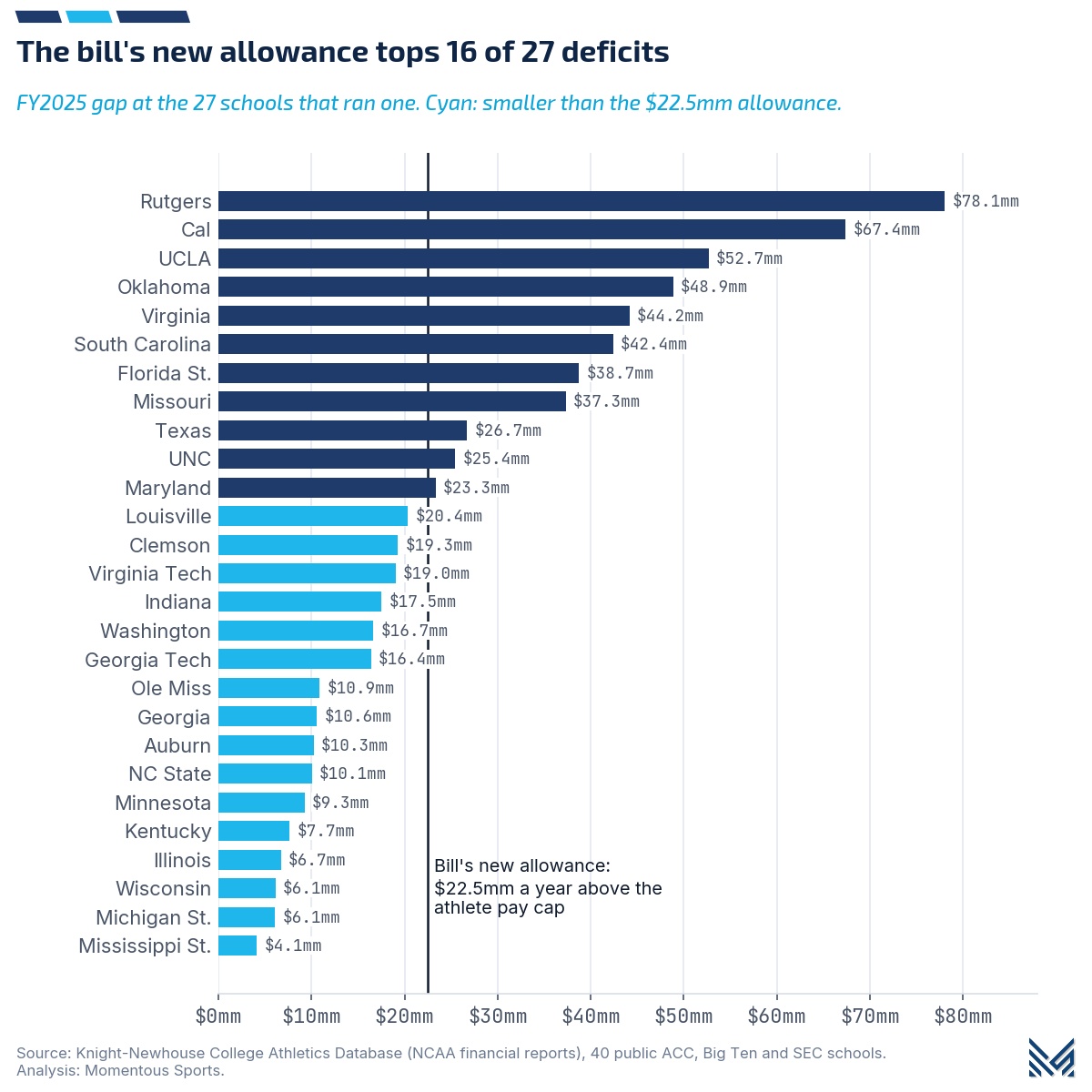
The bill lets each school spend up to $22.5 million a year above the athlete pay cap for nine years, plus up to $5 million more for athletes in sports that don’t earn money. Of the 40 public Power schools, 27 spent more than they generated in 2025. For 16 of them, the new allowance alone is larger than the entire gap. The bill’s cost control bars schools with more than $80 million in athletics revenue from paying a coach more than $500,000 from outside college sports revenue or donations. Each of the 40 earns at least 2.4 times its coaching payroll from athletics, so each can comply without changing what it spends. The new financial reports go to the athletic association, not the public.
The House returns November 9. Speaker Mike Johnson is reportedly waiting until after the midterms, Majority Leader Steve Scalise wants language barring athletes from being treated as employees, and the Congressional Black Caucus opposes the bill. If the House doesn’t act before January 3, the bill dies with this Congress. President Trump praised the Senate vote on September 29.
|
|
Who Is Calling the Play |
|
The bill would let schools sell their rights together under an amended Sports Broadcasting Act, so the people who buy those rights have a stake in how it is read. Disney’s in-house lobbying report for the second quarter, $1.4 million in total spending, lists the Protect College Sports Act and the House’s SCORE Act. Disney also paid Alpine Advisors, the firm of former Rep. Greg Walden, $50,000 in each of the first two quarters for “issues related to college sports.” Amazon’s report, $4.36 million for the quarter, names the bill under sports licensing. Paramount’s, $1.52 million, names it too. Those are total quarterly lobbying figures, not amounts spent on this bill. OpenSecrets counted more than 90 organizations that cited the bill in filings through June 30. Third-quarter reports are due October 20, and I imagine it will be much, much more of the same.
ESPN holds the Playoff through 2031-32 and the SEC’s top package. In mid-September, Cruz spent about ten minutes on College GameDay making the case for the bill. ESPN later gave NAACP president Derrick Johnson a six-minute SportsCenter segment and said it would do the same for other opponents. Puck’s John Ourand reported that ESPN is “pretty lukewarm on the current bill, even after lobbying to have it tailored to their specs.” Cody Campbell, the Texas Tech regent and founder of the advocacy group Saving College Sports, and his wife have given Cruz more than $500,000 over a decade across campaign and PAC accounts, FOIAball reported in June using FEC data. Saving College Sports has spent millions on ads backing the bill.
None of that is unusual in Washington. Every party at that table is protecting a position. The question for a university president is which position is the university’s own.
|
The Easy Throw |
|
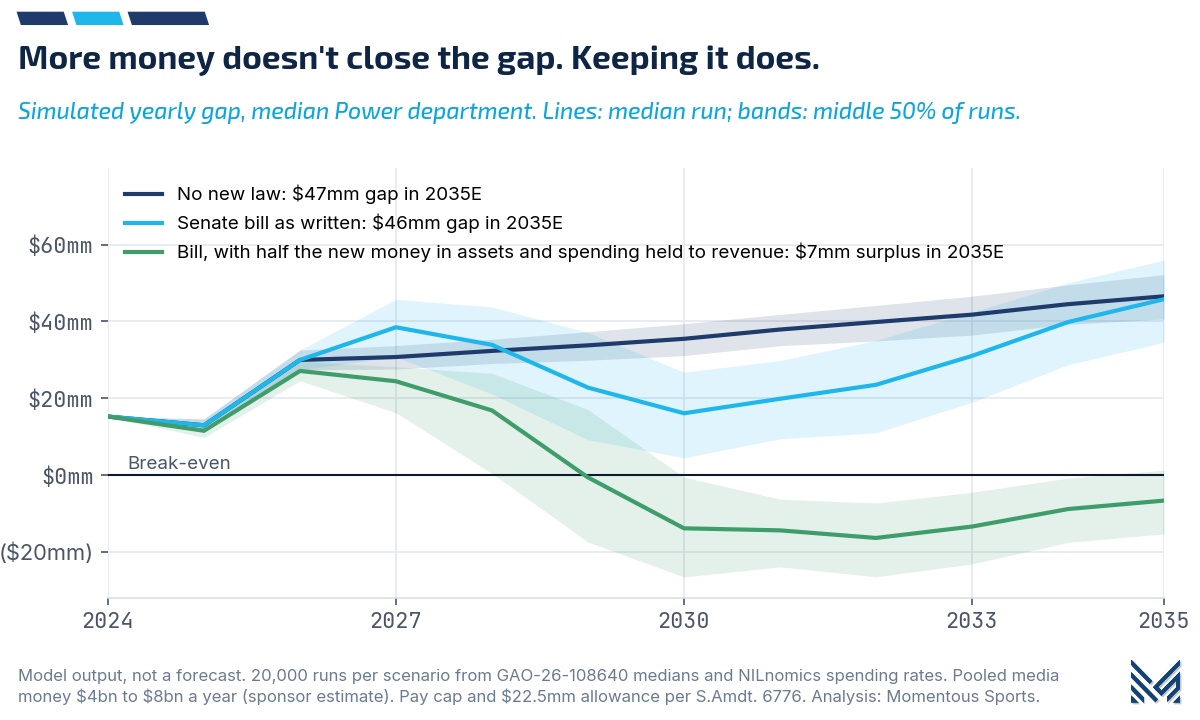
The easy throw is the one standing in front of you. For most universities, that is land they already own next to a venue that fills itself. We simulated a stylized Power department, built from GAO medians, 20,000 times under each policy path. With $4 billion to $8 billion in pooled money and schools free to use the new allowance, the chance of breaking even by 2035 falls under 1 percent. The department breaks even in 71 percent of runs only when spending stops outrunning revenue, the allowance goes unused, and half of the new money goes into assets that earn a return. Remove the assets, and the odds drop to 14 percent.
|
|
|
The market is already taking the short pass. Tennessee broke ground September 19 on 865 Neyland with Arctos, RVX Ventures and Magellan Development Group under a 99-year ground lease that pays the university $1.5 million a year plus a share of revenue. At a typical endowment payout of 4.5 percent, the base rent alone equals the return on a gift of about $33 million that never has to be asked for again. USF broke ground September 8 on its Fletcher District, a nearly $500 million project. Shout out to our lone USF grad Trey Foster who has steadily been making the case for our involvement there, Go Bulls.
Iowa State broke ground September 2 on the remaining phases of CyTown. Kansas has approved incentives of up to $94.6 million for the second phase of its $809 million Gateway District.
But like any solid scheme for a flag football team, structure is where this goes right or wrong. FOIAball reported in July that Kentucky paid Deloitte $2.77 million to stand up Champions Blue, its athletics LLC, and that a South Carolina law firm billed Michigan State more than $250,000 to create two entities, one of which was a for-profit corporation incorporated in Delaware. Michigan State trustees reportedly signed NDAs before reviewing the venture. In North Carolina, the school cited a state privacy law that had not yet taken effect to withhold who its general manager met with in Saudi Arabia while courting a donor. Rent that disappears into an entity nobody can see is not much better than a donor nobody can name. Property income should sit in its own entity, with its own financing and its own reporting, where a governing board can find it.
|
| Rent that disappears into an entity nobody can see is not much better than a donor nobody can name. |
|
|
That is how we invest. We work with schools and developers to own the ground, not the budget. Most capital entering college sports buys into the athletic enterprise through media rights, revenue participations, and minority stakes, inside the same budget that spends $1.46 for every new dollar. We build in the district around the venue, where income comes from tenants and visitors all year and cannot be redirected into a coaching contract. We underwrite the days without games, with an internal benchmark of about 200 activation days a year, and we test every deal against the loss of its anchor.
|
The Second Half |
|
At 8U, the deep ball is a coin flip that lands on the other team. In college, it is a $4 billion to $8 billion promise with no footnote. Congress is about to give athletic departments permission to spend $22.5 million more on the big kid years before the first pooled dollar can arrive, if it ever does. The schools that come out ahead will be the ones that take the throw in front of them, land they already own and rent that shows up every month, and that write a rule so part of the next dollar becomes something that pays them back.
My Seahawks figured that out in one halftime. Three seconds, nothing deep, find the open kid. They are seven and eight years old. I drafted them for their parents, their work ethic, and the fact that they already knew each other; when the plan failed in the first half, that’s exactly what let them change it in the second. Continuity didn’t win us the game. It let us adjust. College sports have spent a decade buying talent and firing coaches. It might try keeping something.
|
|
— Trent
Trent Michels · Managing Director of Investments · Momentous Sports
|
|
|
Disclosures
Not investment advice. This research note is produced by Momentous Sports for educational purposes only. It reflects the author's personal views and is not an offer to sell or solicitation to buy securities; any offering by Momentous Sports will be made solely to verified accredited investors under Rule 506(c) of Regulation D and only through formal offering documents. Consult your own advisors. Past performance is not indicative of future results. Simulation results are model outputs based on stated assumptions, not forecasts. Third-party figures are as reported by the cited sources and have not been independently verified. Disclosure: Momentous Sports Group actively invests in sports-anchored real estate.
© 2026 Momentous Sports. All rights reserved.
|
|


